Posted on

Building the right tool for the job

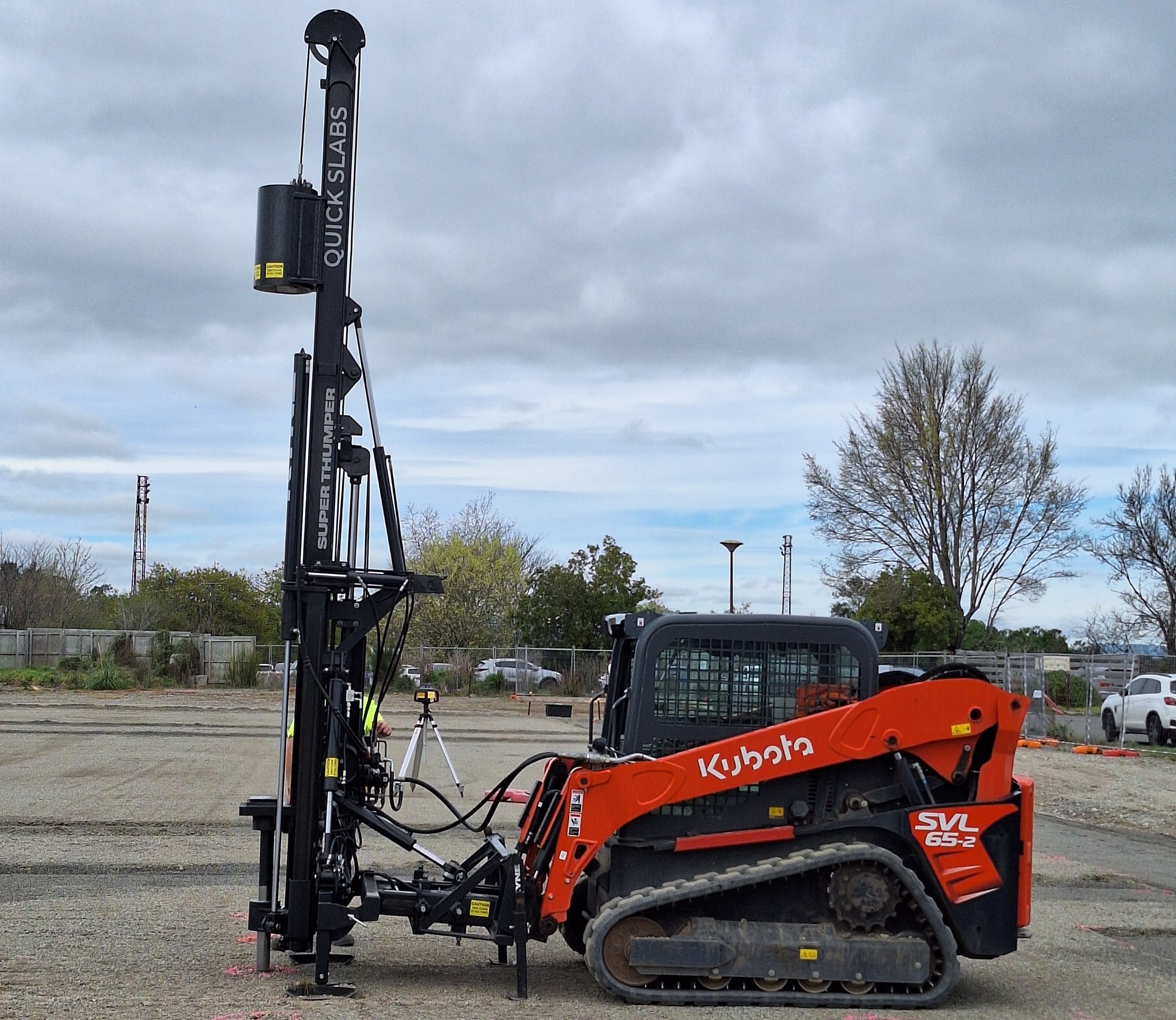
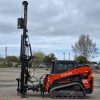
Choosing the right tools for the job is key when installing ground screw building foundations in challenging ground conditions. In a recent job undertaken at the Masterton Medical Centre by Quick Slabs of Wairarapa, Kyne Equipment’s post driver and Rock Spike stood out from the crowd.

Quick Slabs was tasked with installing foundations at the Masterton Medical Centre, a site with extremely challenging ground conditions. The subsoil consisted of demolition material from a previous concrete building combined with river gravel. The original design called for 1-metre-diameter augered concrete piles, some extending over 3 metres to reach virgin ground. Based on site investigations and experience, traditional augering was deemed costly, high-risk, and inefficient.

Large augered piles would have required extensive excavation and removal of contaminated soil, creating environmental compliance issues, higher costs, and logistical complexity. Quick Slabs proposed stop-dig screw piles as a more practical solution, and worked alongside Kyne to come up with a custom-built rock spike to do the job.

Multiple spike sizes were trialled to achieve the ideal balance between penetration and pile engagement. A 90 mm spike created holes that were too large, preventing piles from achieving full load, while a 50 mm spike was too narrow, restricting screw advancement. After testing, a custom 75 mm rock spike from Kyne proved optimal, consistently penetrating the hard, abrasive material while maintaining required pile performance.

This combination allowed screw piles to be installed efficiently, reliably, and repeatably. The solution eliminated ongoing auger replacement, reduced pile damage, avoided large-scale excavation and disposal of contaminated soil, and kept the project on schedule.

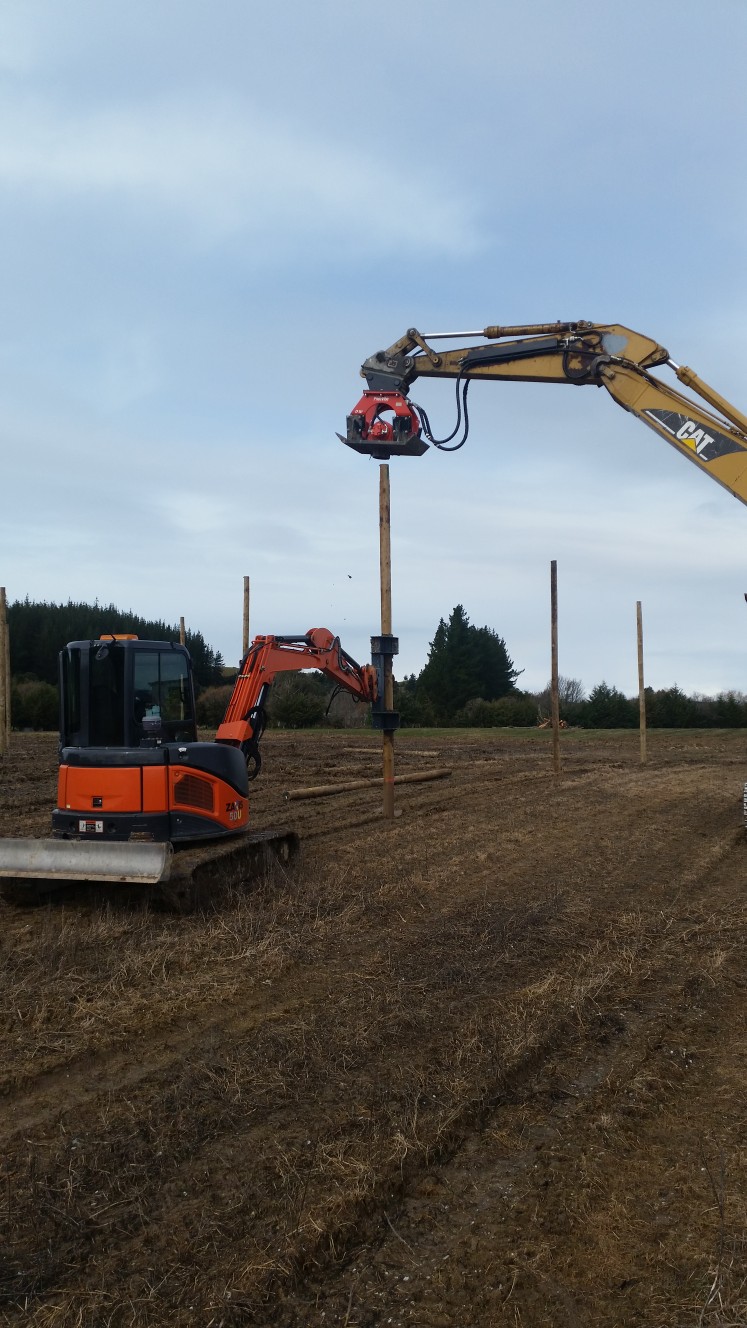
The Kyne Super Thumper with custom rock spikes proved simple to operate on a confined commercial site and delivered significant time and cost savings:

  • Reliable pile installation through demolition fill and river gravel
  • Consistent achievement of 60 kN design load
  • Minimised equipment wear and reduced labour requirements
  • Eliminated the need for large-scale excavation and contaminated soil disposal
  • Streamlined installation within tight site constraints

Following this success, Quick Slabs and Kyne Equipment are exploring enhancements to allow stop-dig screw piles to be installed directly using the post driver, removing the need for a separate auger system. This innovation promises to further reduce equipment, labour, and site congestion on future projects.

Kyne Equipment has an innovative team set-up and specialise in working directly with the end users – we all know the importance of getting the right tools for the job. Kyne has been working with fencers and farmers across New Zealand and Australia to ensure the fencing sector is set up to achieve results, whether it be using our range of post drivers, rotating bases, fencer forks, spinning jennies or augers.

Ryan Garrity, founder and operator of Quick Slabs said, “Quick Slabs would confidently recommend Kyne Equipment’s post drivers with a purpose-built rock spike for installing stop-dig screw piles on similar commercial projects, particularly where ground conditions are hard, abrasive, contaminated, and not suitable for conventional auguring. What could have become a costly and high-risk foundation installation was instead delivered as an efficient and practical solution through innovation, collaboration, and adaptability.”

Ryan went on to say, “The Masterton Medical Centre project demonstrated the strength of Kyne’s integrated solution. By combining the Super Thumper post driver with custom rock spikes we were able to deliver a high-quality, cost-effective foundation solution in ground conditions that would have challenged conventional methods.”

Kyne’s equipment proves to be innovative, reliable, and adaptable, making its post drivers and custom rock spikes the preferred choice for stop-dig screw pile installations in hard, abrasive, or contaminated ground conditions.

Supplied by:

Published in WIRED issue 80/March 2026 by Fencing Contractors Association NZ

You may also like Post and stay testing innovation

Read WIRED online
Follow us on Facebook

© Fencing Contractors Association NZ (FCANZ)
Posted on

Building strength where it matters – Kiwi Structure fills a Northland gap

When Michelle and Rhett Matson started Kiwi Structure, it wasn’t part of a grand business plan. It was born out of necessity, good timing and a very real gap in the Whangarei kiwifruit industry.

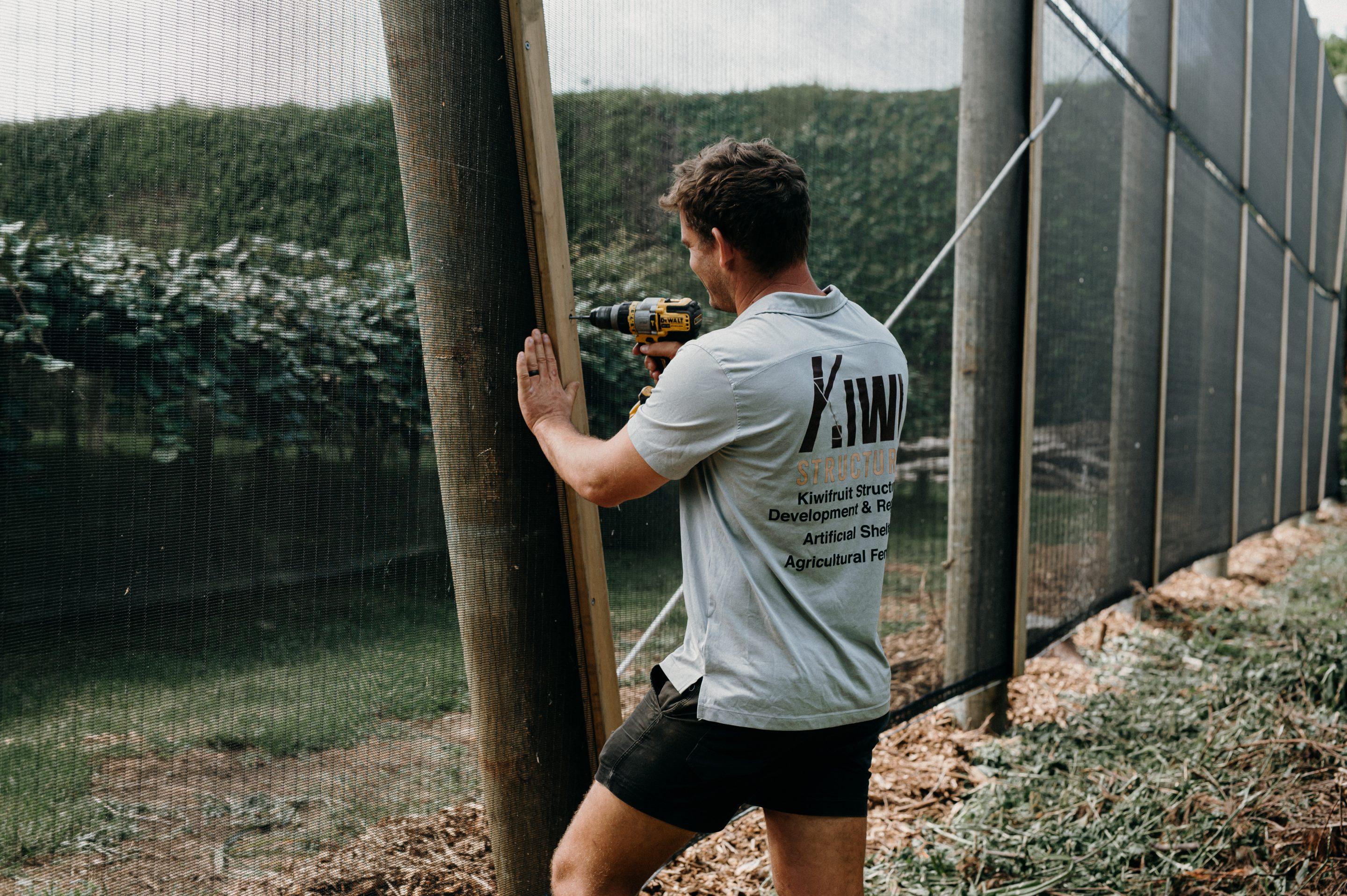
Based in Maungatapere, Northland, Kiwi Structure is a family-owned fencing and orchard infrastructure business that has grown steadily since its establishment in 2020. What began as a one-man operation is now a tight-knit team of four, specialising in kiwifruit orchard development, maintenance and repair, alongside more conventional agricultural fencing.

The catalyst for the business was close to home. When Rhett’s family decided to develop a new kiwifruit orchard, they discovered the nearest specialist contractors were based in Kerikeri. With transport, availability and timing all adding pressure, it quickly became clear Whangarei needed local expertise.

“There was a gap that needed filling,” Rhett said. “And if someone was going to do it properly, it might as well be us.”

From fencing wire to orchard structures

Rhett has been fencing for more than a decade, including time spent working overseas before returning home to Northland to raise a family. His family has been involved in the kiwifruit industry for more than 30 years and has been part of the Maungatapere community for over 150.

That history has shaped the way Kiwi Structure operates today.

“I understand the seasonal pressures growers are under,” Rhett said. “You’re not just building a fence or a structure – you’re supporting a crop, a harvest and someone’s livelihood. That changes how you approach the job.”

Kiwi Structure now works predominantly in the kiwifruit industry, with around 80 percent of its workload coming from orchard developments, expansions, repairs and maintenance. The remaining 20 percent is made up of agricultural fencing, a sector the business leans into during quieter years.

Michelle handles everything behind the scenes. With more than 10 years’ experience in business operations and marketing, she keeps the wheels turning.

“Anything you don’t see on site – that’s me,” she laughs. “Bookkeeping, admin, compliance, marketing and being a general gopher.”

Originally from Hawke’s Bay, Michelle met Rhett overseas before the pair decided to settle in Maungatapere. Today, they juggle business life with raising three young daughters, a reality that shapes how Kiwi Structure runs day to day.

A job that shows what Kiwi Structure does best

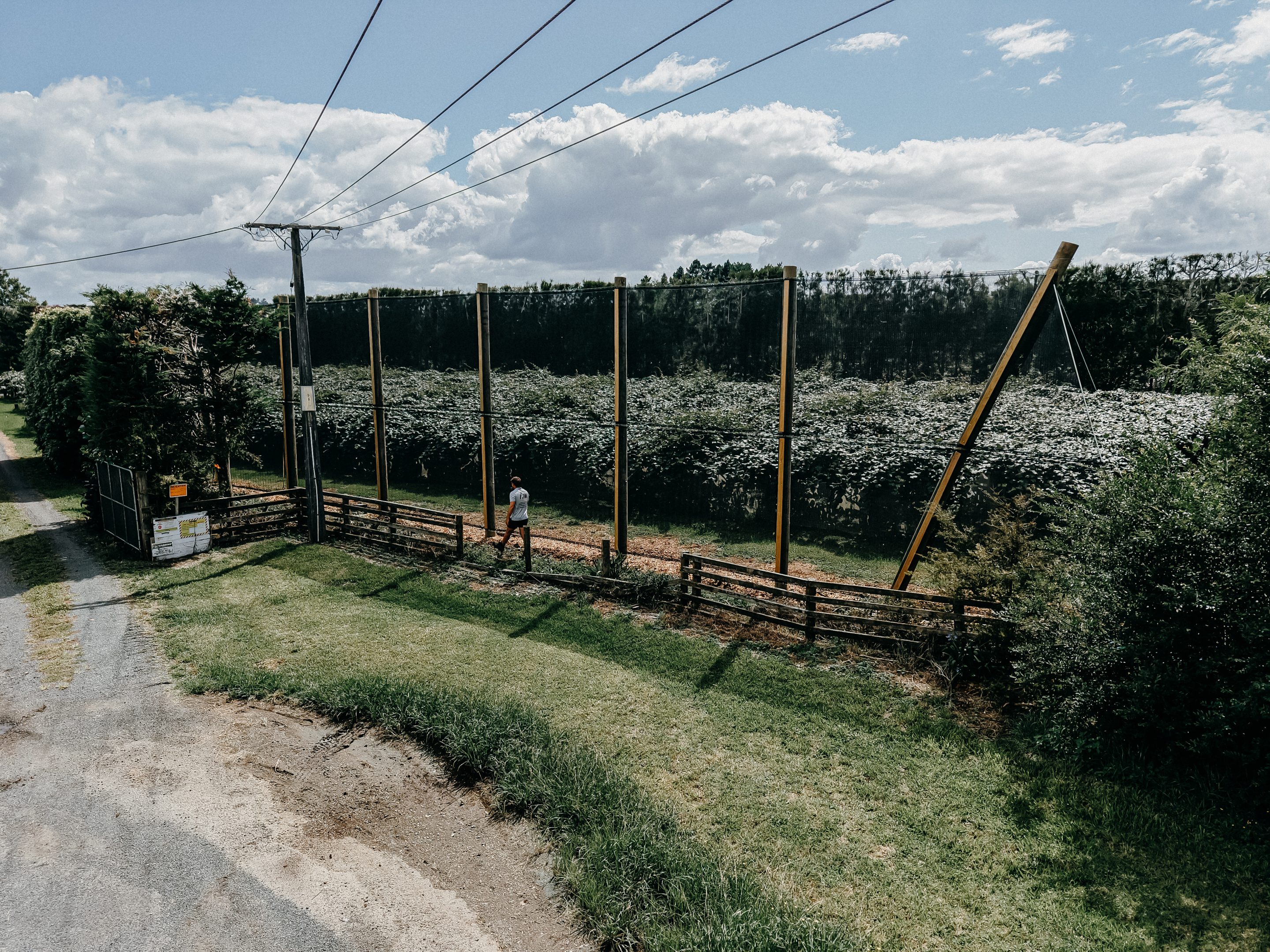
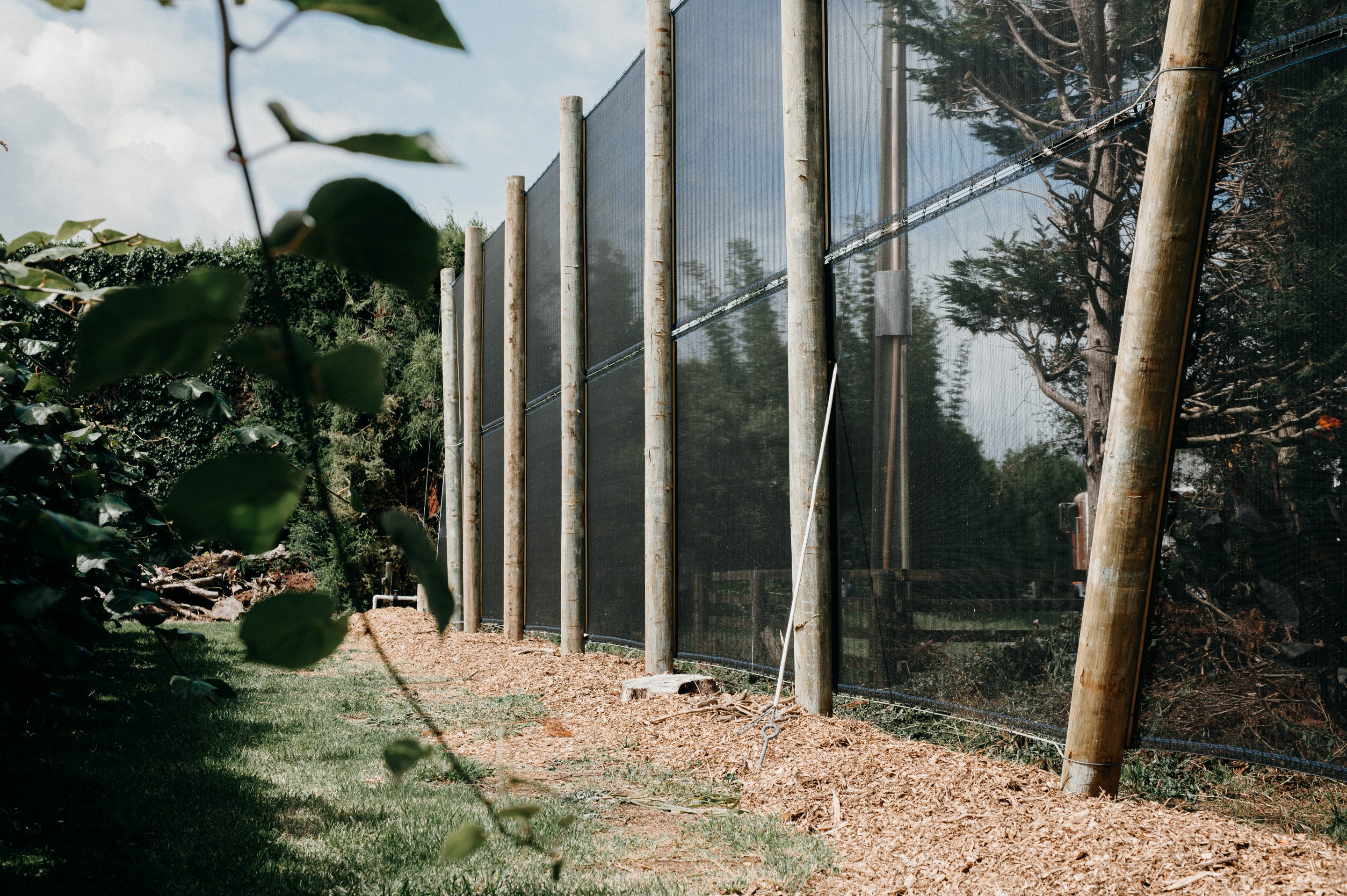
One recent project highlights the specialised nature of the work Kiwi Structure now undertakes – a 30-metre artificial shelter installation for a kiwifruit orchard.

Kiwifruit vines are notoriously sensitive to wind, and effective shelter is critical for both plant health and productivity. In this case, a 30-metre gap existed between established living shelter trees, leaving the orchard exposed. Artificial shelter was the only viable solution.

“This wasn’t a massive job by our standards,” Rhett says. “But it had plenty of complexity.”

The structure was installed in close proximity to live power lines overhead and a high-pressure water scheme below. Before any work began, Kiwi Structure secured a permit from the local power company authorising work within the four metre exclusion zone, to within one metre of the 400 V lines. They also worked closely with the local water utility to identify pipe locations, enabling them to safely operate inside one metre of underground infrastructure.

“That coordination is just part of the job now,” Rhett says. “You can’t afford assumptions when you’re working around services like that.”

The build was completed in stages. While the concrete around the poles was left to cure for two weeks, Rhett and his two-man crew moved on to work elsewhere on the same orchard, maximising efficiency and minimising downtime.

Bigger, higher and tighter

Orchard infrastructure brings a very different set of challenges compared to conventional fencing.

“Everything is bigger, higher and tighter,” Rhett says. “The loads we’re dealing with are on another level.”

Cables used in orchard shelters can be strained to 2.5 tonnes – a stark contrast to the roughly 150kg strain of a standard fence wire. While the team has never had a failure or close call, the consequences of a mistake are never far from mind.

“When you’re five or six metres off the ground, things get your attention pretty quickly,” Rhett says. “You don’t cut corners.”

Health and safety is a daily focus on site. Toolbox meetings are held every morning, and for this particular job, working at height alongside live power and water infrastructure required detailed planning and constant awareness.

“It’s not just ticking a box,” Michelle adds. “Everyone needs to go home at the end of the day.”

The satisfaction of getting it right

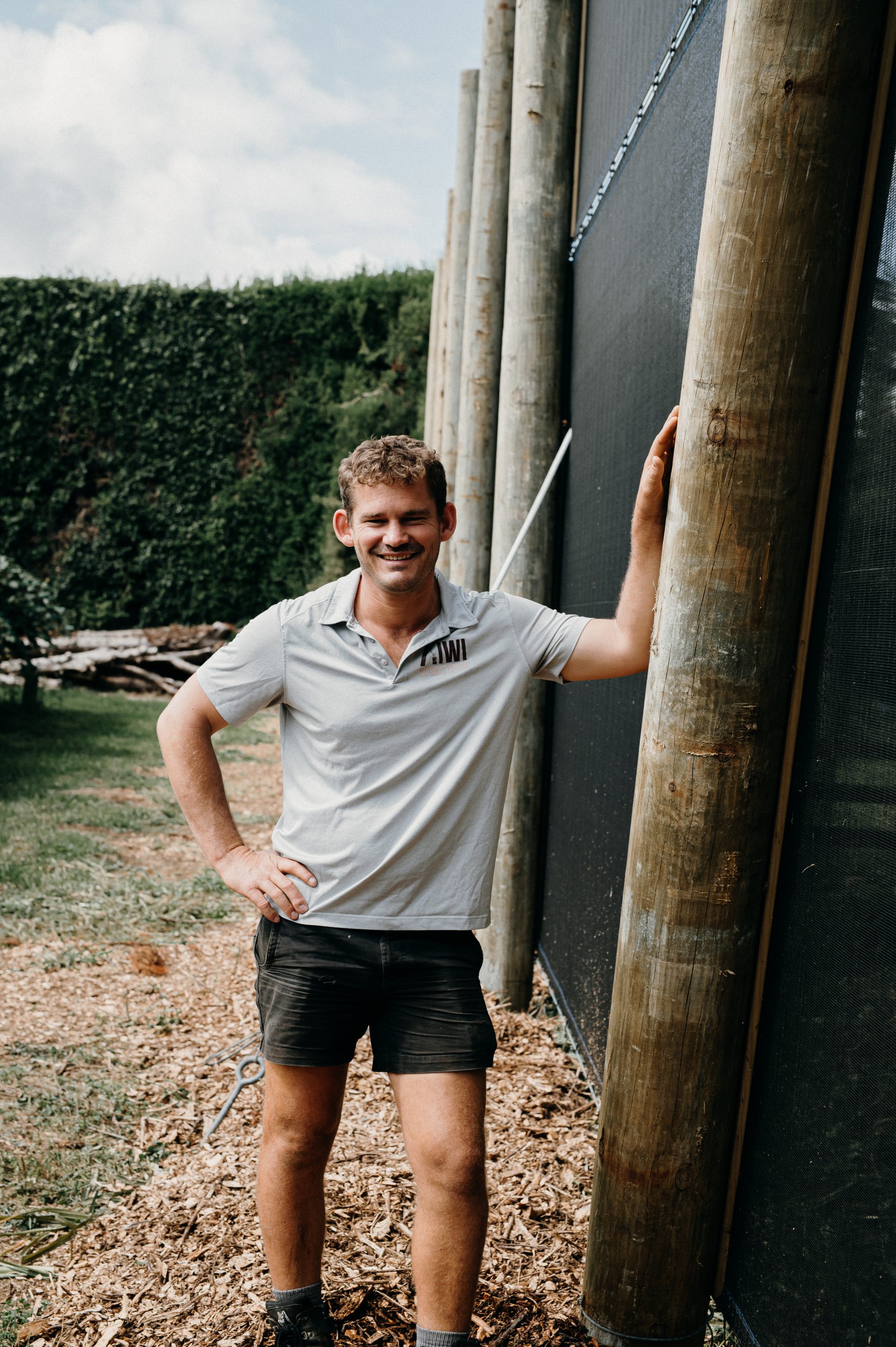
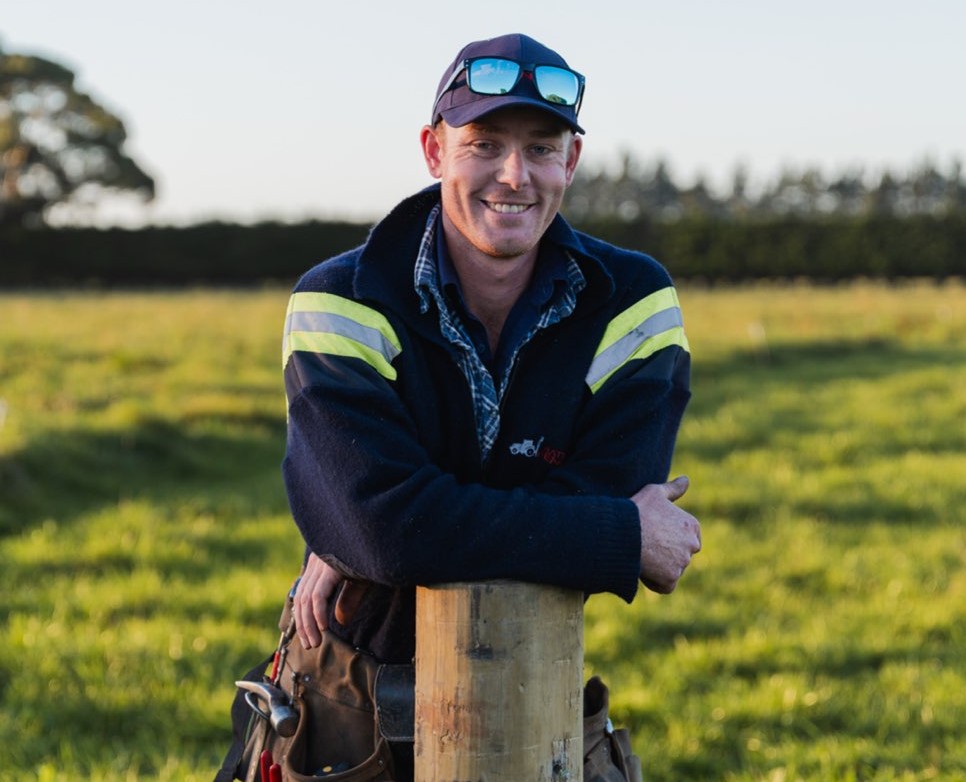
Rhett Matson

Like many fencing contractors, Rhett takes pride in visible progress.

“There’s something really satisfying about looking back at the end of the day and seeing what you’ve achieved,” he says. “You know if it’s been a productive day.”

One of the most satisfying aspects of orchard shelter work, however, is tensioning the windbreak material itself.

“I’ve spent the last few years refining that technique,” Rhett says. “You don’t want flapping or billowing in a well-built artificial shelter. When it’s tight – really tight – and sitting exactly how it should, that’s a good feeling.”

Efficiency also plays a big role in how he works.

“I’m always thinking two steps ahead. It annoys me if I have to walk back to the ute because I’ve forgotten something,” he laughs. “Time in motion matters.”

In the early days, Rhett listened to podcasts while fencing. These days, running a business means his head is often too full to focus on anything but the job.

Weathering the tough years

Kiwi Structure’s growth hasn’t been without challenges. Shortly after the business was established, Covid hit. That was followed by two tough seasons for the kiwifruit industry, with low returns and damaging weather events slowing investment.

“When things are tight, growers batten down the hatches,” Rhett says. “Only the essential jobs get done.”

During that period, the business pivoted towards agricultural fencing to stay busy and keep cashflow moving.

“When kiwifruit picked back up, we were straight back into it,” Rhett says. “But having that flexibility made a big difference.”

That adaptability has paid off. Kiwi Structure now has a strong base of repeat clients, many of whom call them back for new developments as orchards expand, or for ongoing maintenance of existing structures.

Looking ahead

In 2025, Kiwi Structure was named a finalist in the Northland Business Excellence Awards micro-business category, recognition that reflected both their workmanship and the way they operate.

Rhett is also currently completing his Level 4 Certificate in Fencing through NorthTec, underscoring his commitment to continual improvement.

“I still want to learn,” he says. “You can always do things better.”

For Michelle and Rhett, Kiwi Structure remains very much a family business – built on local knowledge, strong relationships and doing the job properly the first time.

“At the end of the day,” Michelle says, “we’re building structures that have to stand up to Northland weather and support people’s livelihoods. That responsibility isn’t lost on us.”

And in a region where specific expertise once had to be trucked in from hours away, Kiwi Structure has become exactly what it set out to be – a strong, reliable solution built close to home.

Written by Alice Scott

Published in WIRED issue 80/March 2026 by Fencing Contractors Association NZ

You may also like Lifestyle fencing is all part of the job

Read WIRED online
Follow us on Facebook

© Fencing Contractors Association NZ (FCANZ)
Posted on

Install quickly and confidently with Waratah Longlife Blue 25kg coils

When it comes to reliability and ease of use, the Waratah Longlife Blue 25kg coils are ideal for contractors who value performance and ease of use.

In challenging environments where access is limited and conditions are unpredictable, having a fencing product that can be moved easily and installed confidently makes a significant difference on the job.

Contractors across New Zealand are going blue, just like South Canterbury fencing contractor Dan Douglass, owner of Dan Douglass Fencing. Dan says the lighter coils’ weight are a major advantage when working in hill country. “The 25kg coils are great for New Zealand. A lot of hill fencing means you need to carry it in by hand, so if you can carry a Longlife Blue® 25kg coil in by hand, it’s great,” he explains. Dan also values the product’s consistency, noting that it performs reliably and remains stable in price, allowing him to plan jobs with confidence.

Another key benefit of Waratah Longlife Blue® fence wire is how it works as part of a complete fencing system. When used alongside JiO® Star posts and JiO® Clips, the installation process becomes faster, easier, and more dependable. As Dan points out, having the entire fence designed as a system means it is quicker to build while delivering long-term performance and protection for farmland.

For contractors, achieving the same result every time is essential. Dan says the quality and consistency of Waratah Longlife Blue® sets it apart. “I like the quality and the consistency of the wire. It’s always the same,” he says.

That consistency is echoed by fencing contractor Tom Evans, who regularly works in steep, rocky terrain where access is difficult and conditions can be harsh. “The hardest part of my job is the terrain and the weather,” Tom says. “I like working with Waratah because of the quality, it’s easier to use. There is no comparison between Waratah and cheaper competitors.” He explains that using inferior products in the past has led to dangerous situations, with fencing materials failing while being installed on difficult ground. “Longlife Blue® wire has that extra protection. It’s worth it in the long run, and it makes sense to use it.”

When advising farmers, Tom consistently recommends Waratah fencing products. “Farmers like quality, especially in hill country. You don’t want to be doing things twice if you don’t have to,” he says. Built for demanding landscapes and designed to work as a complete system, Waratah Longlife Blue® 25kg coils provide a practical, reliable, and long-term fencing solution for contractors and farmers across New Zealand.

For more information on Waratah products, visit www.waratahfencing.co.nz or call Brendon Crequer on 021 393 010.

Supplied by:

Published in WIRED issue 80/March 2026 by Fencing Contractors Association NZ

You may also like Choose style and quality with the Waratah Flex Rail® System

Read WIRED online
Follow us on Facebook

© Fencing Contractors Association NZ (FCANZ)
Posted on

Strainrite: tools and solutions that keep vineyards strong

Across horticulture and viticulture, growers are under constant pressure to do more with less.

Labour shortages, rising input costs and the need for long-term infrastructure performance mean that every decision – from pruning to tying and trellis setup – must deliver efficiency, durability and consistency.

That’s where Strainrite Fencing Systems’ vineyard professional tools and solutions play a key role in supporting modern vineyard operations.

Clean cuts and smarter pruning

Pruning remains one of the most critical tasks in the vineyard calendar. Done well, it sets the foundation for vine balance, fruit quality, and long-term plant health. Timing and technique matter, but so do the tools.

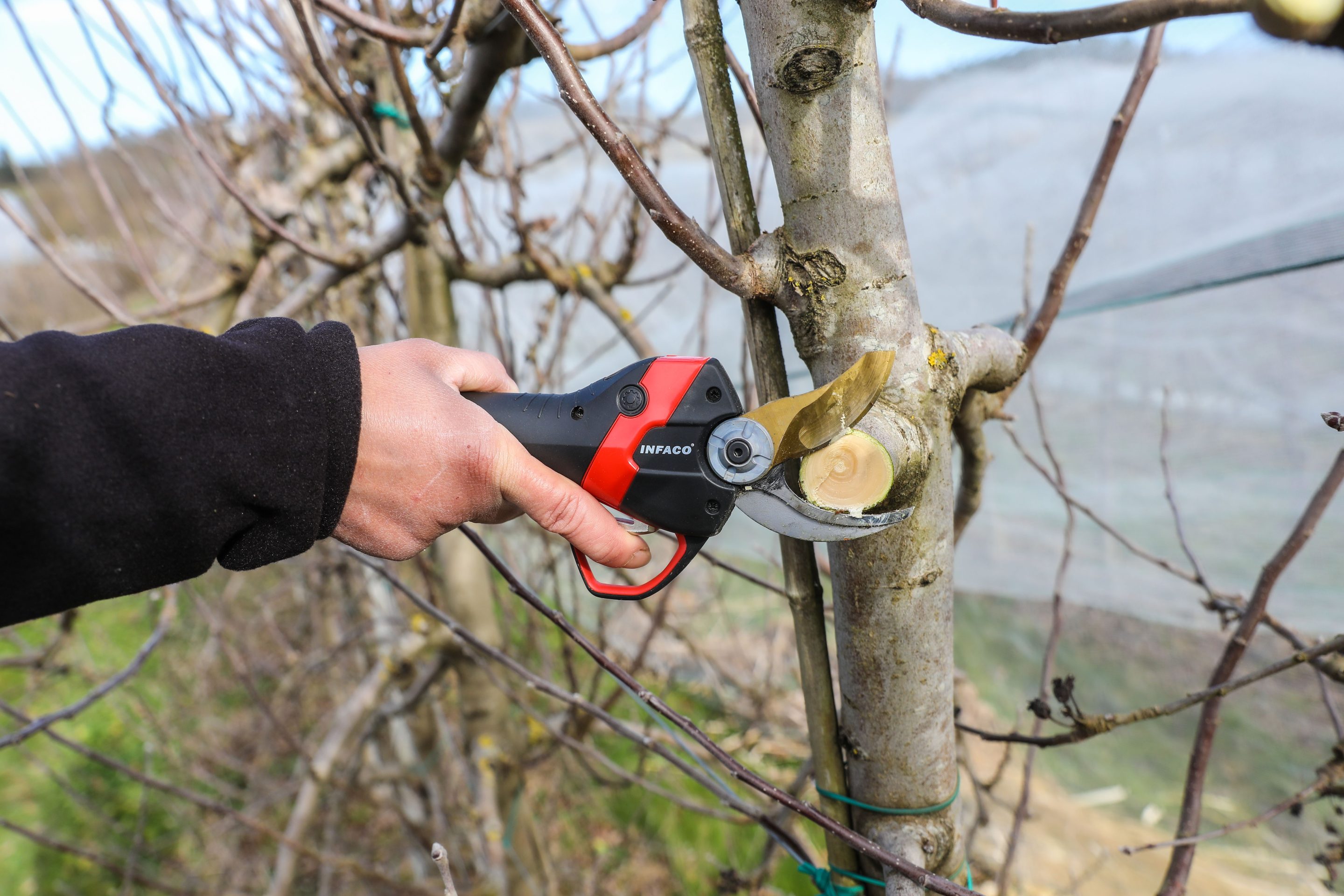
INFACO electric pruning shears, distributed by Strainrite, including the F3020, deliver clean, precise cuts while reducing operator fatigue. Consistency is crucial when pruning large blocks, and electric pruners help maintain cut quality throughout the day. Built-in safety systems and ergonomic design support safer, more comfortable work during long winter pruning sessions.

As vineyards scale up, reliability and repeatable performance become just as important as cutting power – making professional-grade tools a worthwhile investment.

Faster, more consistent vine tying

Tying is another labour-intensive job that benefits from mechanisation. INFACO’s AT1000 electric tying tool provides fast, consistent tying across a wide range of vineyard training systems, including single and double Guyot, Chablis, arching, and trellis applications.

The AT1000’s fully automatic operation, adjustable twist settings and high-capacity reels allow operators to work efficiently with minimal interruption. Thousands of ties can be completed on a single battery charge, supporting productivity during peak periods while reducing hand and wrist fatigue.

Consistent tying saves time and contributes to uniform vine positioning, improving canopy management, airflow and light penetration.

Superior bungy performance in harsh environments

Strainrite’s Premium Bungy range is widely used in horticulture and viticulture for irrigation droppers, vine support and flexible trellising applications. It is superior to all other bungy cords available, particularly in demanding outdoor environments.

Unlike traditional bungy cords that use multifilament natural rubber cores, which perish rapidly when exposed to the elements, Strainrite Bungy features a unique solid core made from specially formulated, UV-protected rubber. Combined with a tightly braided sheath incorporating stainless steel wires and high-denier polyester fabric, pre-treated with a UV inhibitor, it provides an additional barrier of protection.

In short, Strainrite Bungy is built to last and perform in harsh environments, maintaining elasticity, strength and reliability season after season.

Permanent wire strainers for vineyard trellis systems

A vineyard trellis is only as strong as its tensioning system. Strainrite offers a range of permanent wire strainers for horticultural and viticultural applications, including Insul-Clip, Durashield, XT1, and Cliplock strainers.

These strainers are designed for long-term installations where wire tension must be maintained and adjusted as vines mature and seasonal loads change. Permanent strainers allow growers to re-tension trellis wires efficiently, helping protect vine structure, reduce maintenance and extend trellis life.

For commercial vineyards focused on longevity and return on investment, reliable wire strainers are a critical component of vineyard infrastructure.

An integrated approach to vineyard efficiency

From pruning and tying to irrigation support and trellis tensioning, modern vineyards perform best when tools and infrastructure work together. Strainrite Fencing Systems’ vineyard professional tools and solutions, including INFACO pruning and tying equipment, Premium Bungy and permanent wire strainers, support growers in building systems that are efficient, durable and designed for long-term performance.

In an environment where labour, time and reliability matter more than ever, investing in quality solutions across every stage of vineyard management ensures consistent results – season after season.


Supplied by:

Published in WIRED issue 80/March 2026 by Fencing Contractors Association NZ

You may also like Strainrite launches the new Mini Reel

Read WIRED online
Follow us on Facebook

© Fencing Contractors Association NZ (FCANZ)

Posted on

Wiggy’s World: Finding your why in the middle of the grind

By the time this goes to print, most people will have forgotten what their New Year’s resolution was and will be back in the grind of working to stay afloat or to buy that dream boat or toy.

We get wrapped up in the day-to-day life of survival and the pressure of commitments until some date, event, or moment in time makes us reassess who we are and what we do. The old cliché comes out: “What is your why?”

But it is a question that needs an answer to really balance your own needs, versus the needs of your career or business. Your ‘Why’ may change depending on what stage in life you are and what personal position you may now sit in. For example, the young fencer coming out of school will have desires, hopes and ambition. A life of unknowns, with responsibility only for their own needs – and perhaps a date on Friday night.

The 40-year-old business owner with five staff, machinery and a family is at the other end of the spectrum. I expect those reading this will know the pressure this stage of life brings and remember the pressure of dating with a dry smile.

But just as the younger version of you put your best foot forward on those Friday nights to portray strength and confidence, the older version of you needs to do the same, to be the best you can be for the many aspects of your life now.
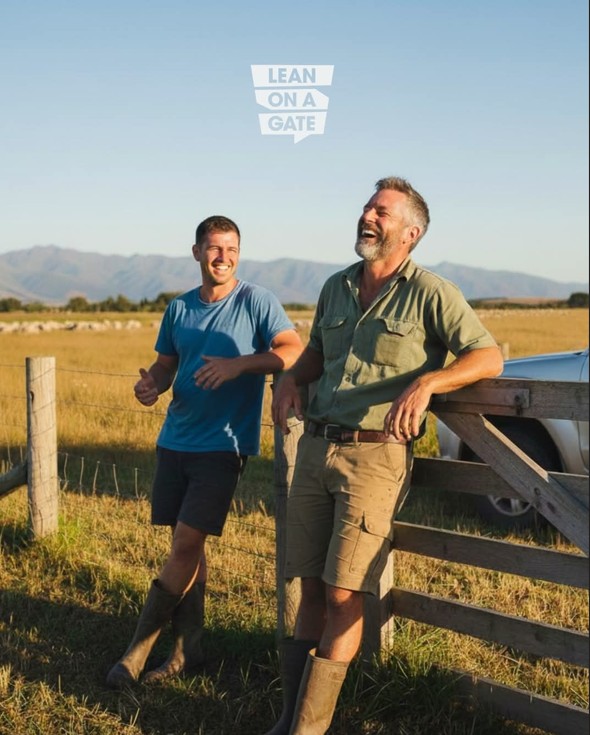
What if this year wasn’t about being everything for everyone? What if it was about tuning in – to YOUR needs, YOUR limits, and YOUR wellbeing? Showing up for yourself doesn’t have to mean dramatic change. Sometimes it looks like going to bed earlier. Saying no when something’s too much. Making time for things that matter to you. Speaking up when something’s not right, especially if that’s to do with your own wellbeing. It means recognising that your needs matter too – you don’t have to wait until you’re completely burnt out to honour them.

This year will be a big year for me and the team at Lean on a Gate. I am a little bit anxious about the amount of work to be delivered – generated by the needs of so many we have spoken to.

What have we created? A training programme for rural professionals and those in the service industries who regularly visit those in need or who work with many who could use a supportive hand on their back. But it’s not just us anymore; the partnership with Mates in Construction and their support networks for those who go through the training programme will be a game changer in rural mental health, and this helps me quieten that anxiety. My biggest worry was what would happen to the work we do if I, or one of the team at LOAG, wasn’t able to continue it. This new partnership gives that work longevity and stability.

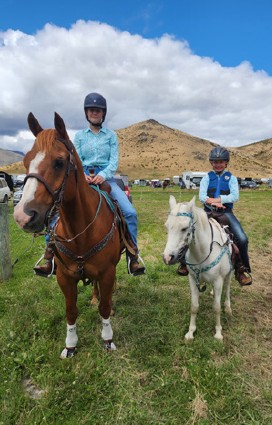
I prioritised my family time this Christmas with a trip away; three horses in a float and the three ladies in my life who often miss out due to my commitments. Hardly any arguments, great friends to share meals with and to introduce our girls to, and some success and growth in their riding and competing. I wasn’t that keen to go, due to my having moved away from that part of my life recently. But it was refreshing: my eldest daughter showed just how competitive and determined she is (no wonder we clash occasionally); my youngest daughter winning the biggest smile competition every time she rode; and my wife – who puts everything into ‘us’ – got to enjoy her passion, with the support that allowed her a less stressful trip and to enjoy her moments of happiness as we travelled. Right there is my new ‘Why’.

So for me, the focus has changed. The work we do in the mental health space needs me to focus more on what makes me happy. Supporting my family, a bit of fishing and hunting where possible, and of course the knowledge that what we do matters. (If anyone is looking for a mate on a boat or for a wee hunt, please let me know, shameless plug!).

I had very limited success on Friday nights, as I remember, but they say it’s all about the effort you put in. Thank goodness we find worthy causes as we age and focus on more important things. What I have found is that life finds its own path, and whatever you do matters!

This year, make space for yourself. The people around you benefit when you’re looking after yourself too. www.leanonagate.co.nz

Published in WIRED issue 80/March 2026 by Fencing Contractors Association NZ

You may also like Wiggy’s World – December 2025

Read WIRED online
Follow us on Facebook

© Fencing Contractors Association NZ (FCANZ)

Posted on

Southern Field Days 2026

Google what the weather is like in Southland in mid-February and you are told that “In February, Southland experiences its peak summer weather, characterised by mild to pleasant temperatures, long daylight hours, and high, often changeable, rainfall.

While it is one of the warmest times of the year, sudden showers, cool evenings, and winds are very common.” Which basically means pack for every kind of weather. This couldn’t have been more accurate for the three days of the event, with rain and sun on day one, a sweltering 30 degrees on day two, and rain and wind on day three. Farmers and fencers are a hardy bunch though, so we still had plenty of people pop by.

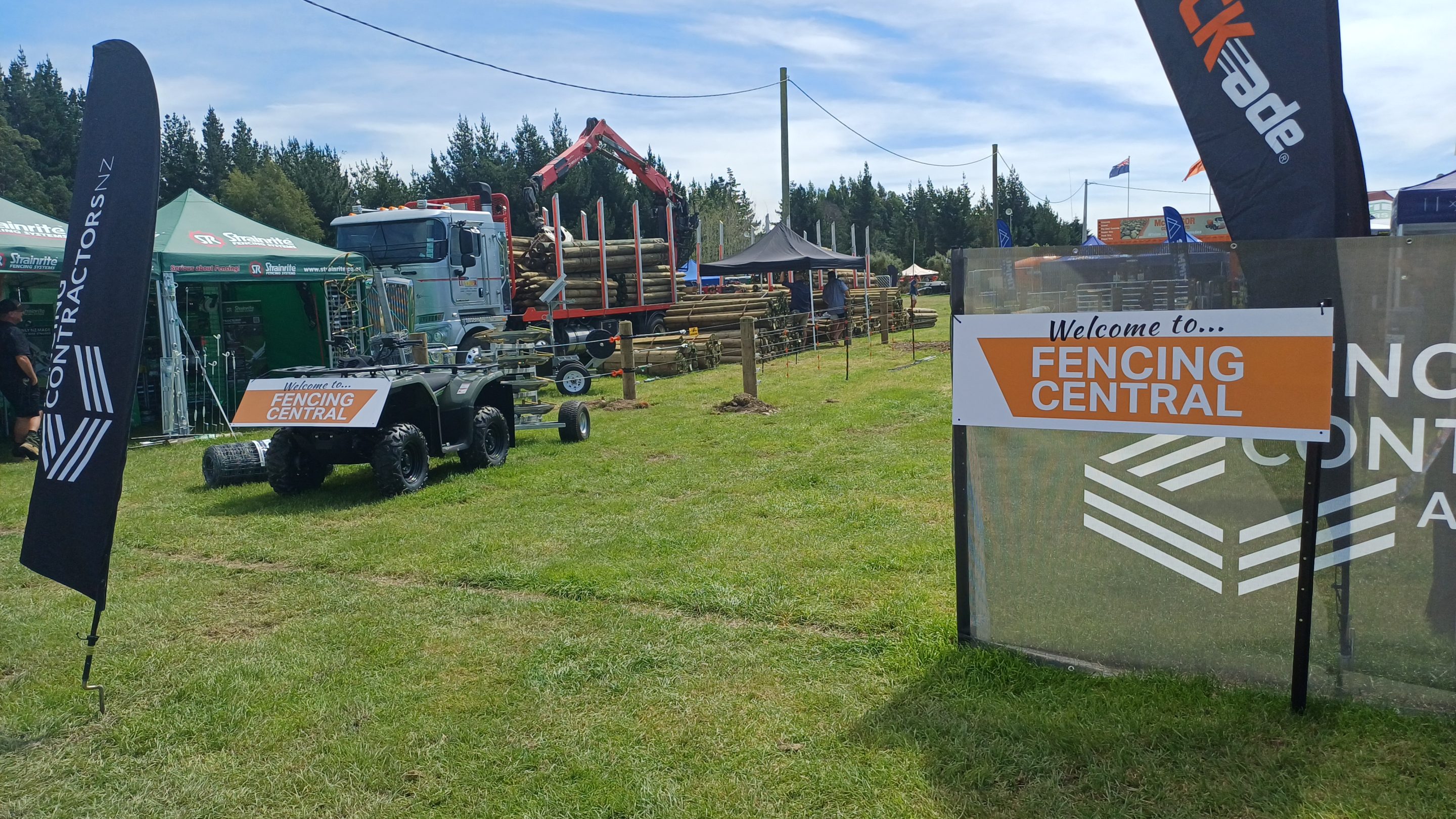
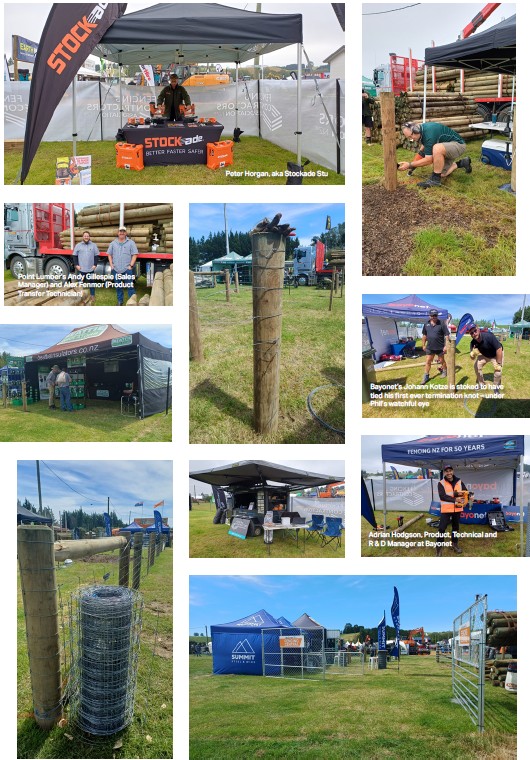
This was our first time at the Southern Field Days in a number of years, and certainly the first time we had brought Fencing Central to the people. It was great to be back on site and reconnecting face-to-face with contractors, farmers, suppliers, and industry supporters. Under the FCANZ umbrella we were joined by seven of our Gold partners and their local sales reps, providing a one-stop hub in which visitors could talk all things fencing. Having everyone together in one space made it easy for people to ask questions, compare products, and have practical, real-world conversations about fencing solutions.

A demonstration area was set up in the centre of the site, where visitors could see and touch Partner products rather than just hearing about them. This hands-on approach was great for those wanting a closer look at systems or materials they hadn’t seen before.

To keep things spicy, we ran a knot-tying competition, which added a bit of friendly rivalry and a lot of entertainment. While some of the work was questionable, most of it was excellent, and it was great to see such strong skill levels on display. Everyone who gave it a crack went into the draw for a $500 wire voucher, thanks to PGG Wrightson, which certainly helped encourage participation and enthusiasm.

Congratulations to Brent Jamieson, who was the lucky person to have their name picked out of the hat by Craig “Wiggy” Wiggins, Association Patron and head of our charity of choice, Lean on a Gate. A big thanks to Craig for taking the time to be involved and for the ongoing support he provides to the Association and the work he and his team do for mental health in the wider industry.

Thanks to Gold Partners Gallagher, Stockade, Bayonet, Beattie Insulators, Strainrite, Summit and Point Lumber for joining us to deliver what is undoubtedly a great concept – and one we look forward to repeating at the South Island Agricultural Field Days in Kirwee next year. The feedback from both partners and visitors was definitely positive, reinforcing the value of bringing industry expertise and product knowledge together in one accessible space. Next stop for Fencing Central? Mystery Creek in June. See you there!

Written by Jaime Bigwood & Phil Cornelius

Published in WIRED issue 80/March 2026 by Fencing Contractors Association NZ

You may also like Weather or not, we fence

Read WIRED online
Follow us on Facebook


Posted on

FCANZ Industry Awards 2026

Now in its fourth year, the FCANZ Industry Awards return to celebrate those who truly embody the Association’s mission – championing fencing as a professional trade, delivering exceptional workmanship, and upholding best-practice standards across the industry. Here are this year’s categories.

Trainee of the Year – Level 3

This award recognises an individual who undertakes fencing work as their primary form of employment and who completed the NZQA National Certificate in Fencing Level 3 course in 2025. They will have demonstrated to the tutor that through the course, they have obtained the skills and knowledge for excellent fence line installation.

Criteria

  • Completed NZQA Level 3 course during 2025
  • Employer is a FCANZ member (including during the period the trainee was enrolled in the course)
  • Nominated by the course tutor
  • Shows excellent knowledge of fence line practices, and it is evident that they have been trained well by their employer

Selection process

  • 1 nominee per course, put forward by the course tutor
  • FCANZ to facilitate the appointment of three independent judges
  • Nominees are invited to attend the FCANZ Gala Dinner, where the winner is announced

Level 4 Excellence

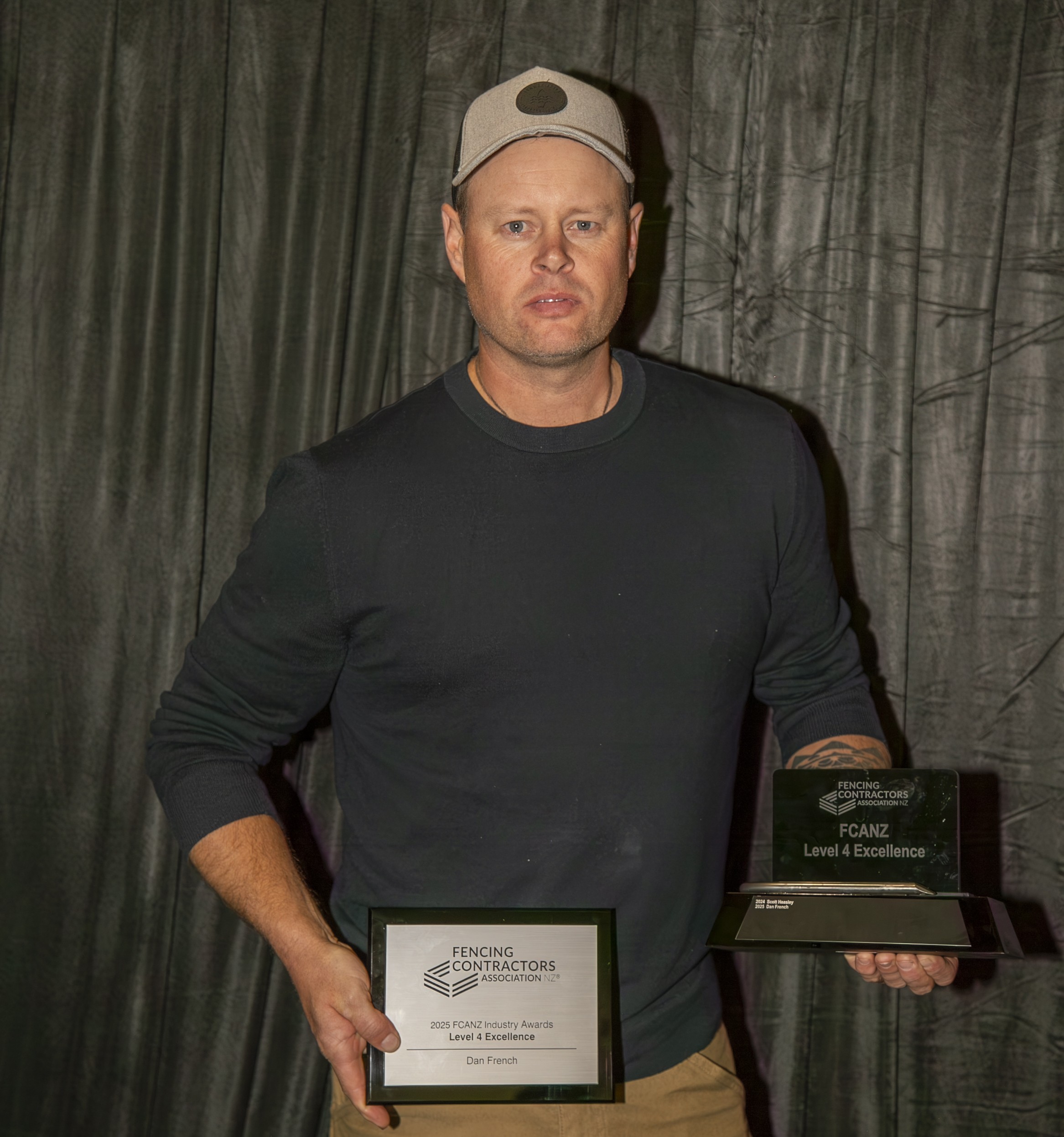
This award recognises the graduate of the NZQA National Certificate in Fencing Level 4 who consistently displayed excellence across their coursework. Awarded to only one of the 2025 graduates, this award acknowledges the student who consistently produced excellent work, identifying them as a true asset to the fencing industry.

Criteria

To be considered for this award, students must have excellent attendance and consistently:

  • Participate openly in all group discussions, assisting other members of the group by sharing their knowledge and experience while maintaining an open mind to the opinions and experience of other members,
  • Complete all study and assessments within appropriate time frames while demonstrating a willingness to achieve and maintain consistent gains within their learning,
  • Demonstrate a willingness to accept new and alternate methods and systems, and the ability to adapt their thinking to consider and apply gained knowledge where applicable into their approach to the operational processes within their given business and working environment.

Selection process

  • Nominees for this award will be identified by the NorthTec Course tutor.

The recipient will also be determined by the tutor according to the criteria above.

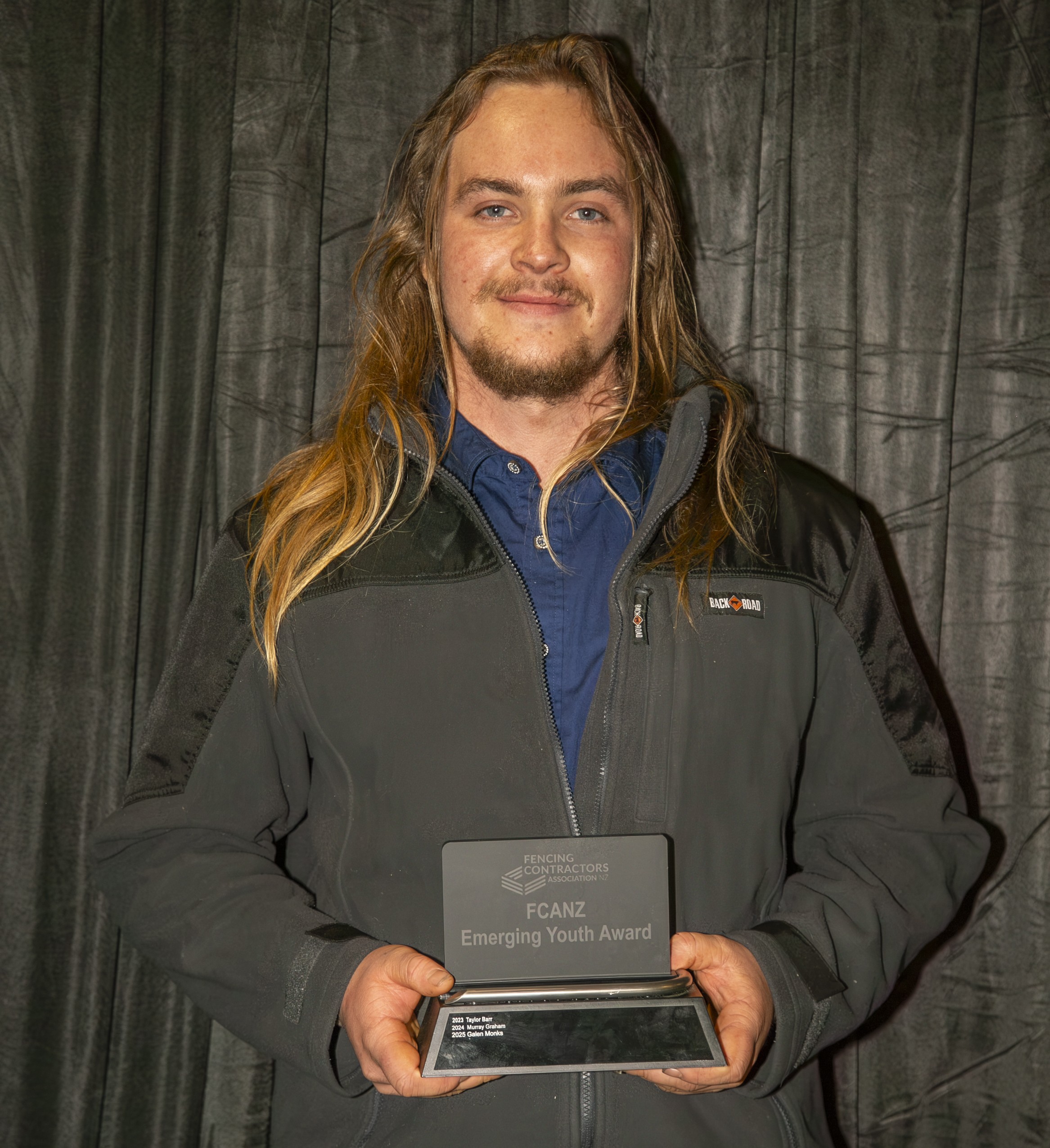
Emerging Talent – Youth

This award is for those in the industry who have demonstrated a commitment to fencing as a career opportunity and demonstrated growth and excellence in their workplace.

Criteria

  • Under 25 years of age
  • Employed in the industry by a FCANZ member
  • Been employed by the employer for a minimum of two years

Signed Employer Declaration confirming worker:

  • has demonstrated good work habits
  • is punctual and reliable
  • demonstrates interest in the job and a willingness to learn
  • has demonstrated good uptake and understanding of fence line systems
  • has good uptake of Health and Safety and demonstrates a willingness to engage

Selection process

Nominees will be expected to provide video evidence of their work, and to attend an online meeting with the independent judging panel, which will decide the winner.

Women in Fencing – Excellence

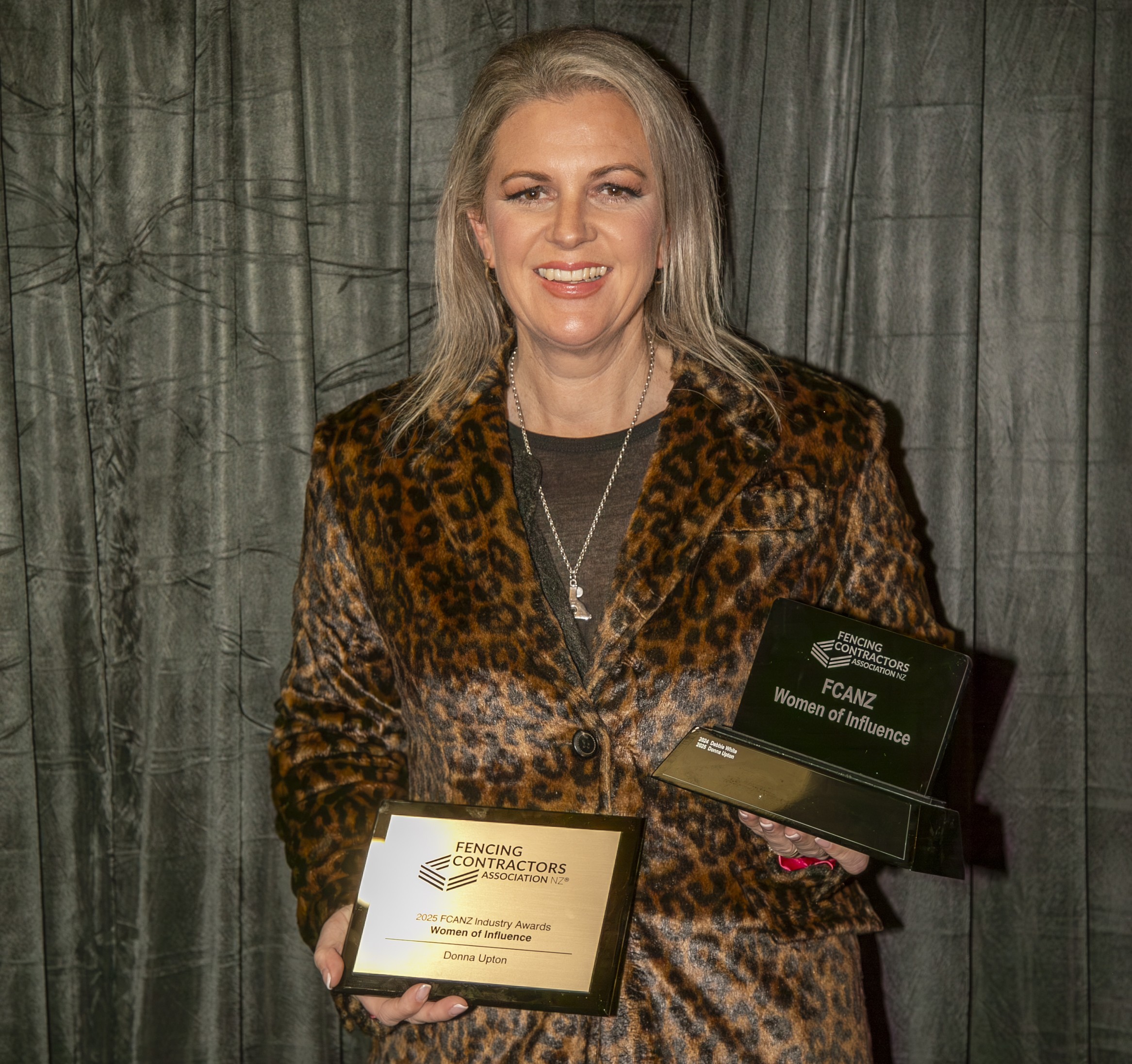
This award recognises a woman who supports and advances the New Zealand fencing industry. Recipients of this award are chosen by the Board to acknowledge the great work put in by women in a predominantly male environment, adding value on the fenceline or within the wider fencing industry.

Industry Contribution

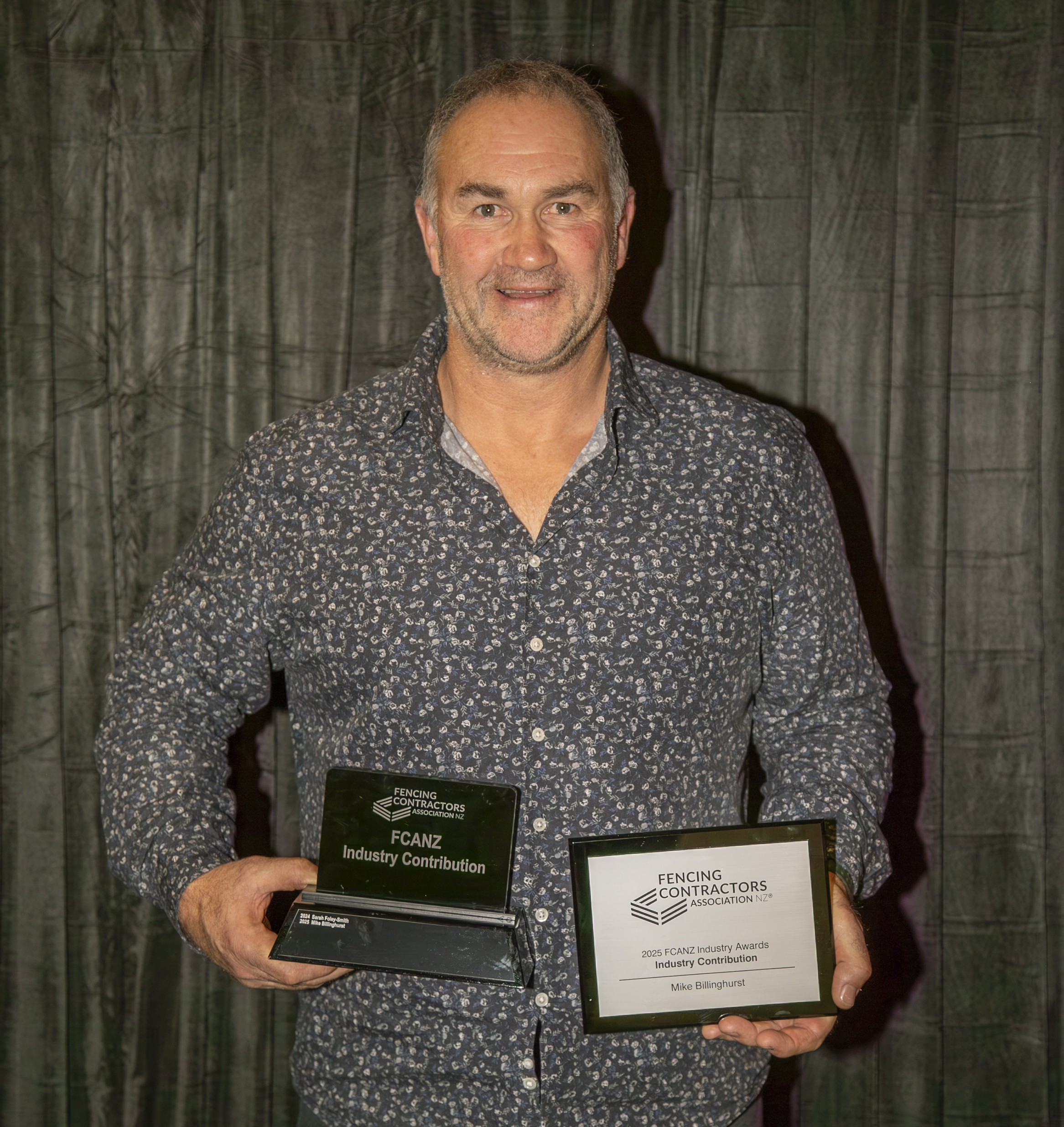
This award recognises and acknowledges individuals who go above and beyond to champion and support the fencing industry’s growth and development. Recipients of this award are chosen by the Board for their commitment to the betterment of the fencing industry as a whole.

FCANZ Legacy Award

The FCANZ Legacy award (formerly known as the Lifetime Award) is the highest award that FCANZ can bestow. The achievements and contributions of the individual must truly be outstanding and significant, over a sustained period of time. Recipients must have contributed to the industry across several capacities, contributing significantly to the improvement of industry and supporting the Association to meet its goals. To be eligible to receive this award, the individual must have been an FCANZ member at some time in their career.

The FCANZ Legacy award is a special and infrequently awarded honour, with recipients receiving honorary Life Membership.

Published in WIRED issue 80/March 2026 by Fencing Contractors Association NZ

You may also like 2025 FCANZ Awards Celebrate Industry-wide Excellence

Read WIRED online
Follow us on Facebook

© Fencing Contractors Association NZ (FCANZ)


Posted on

From the archives

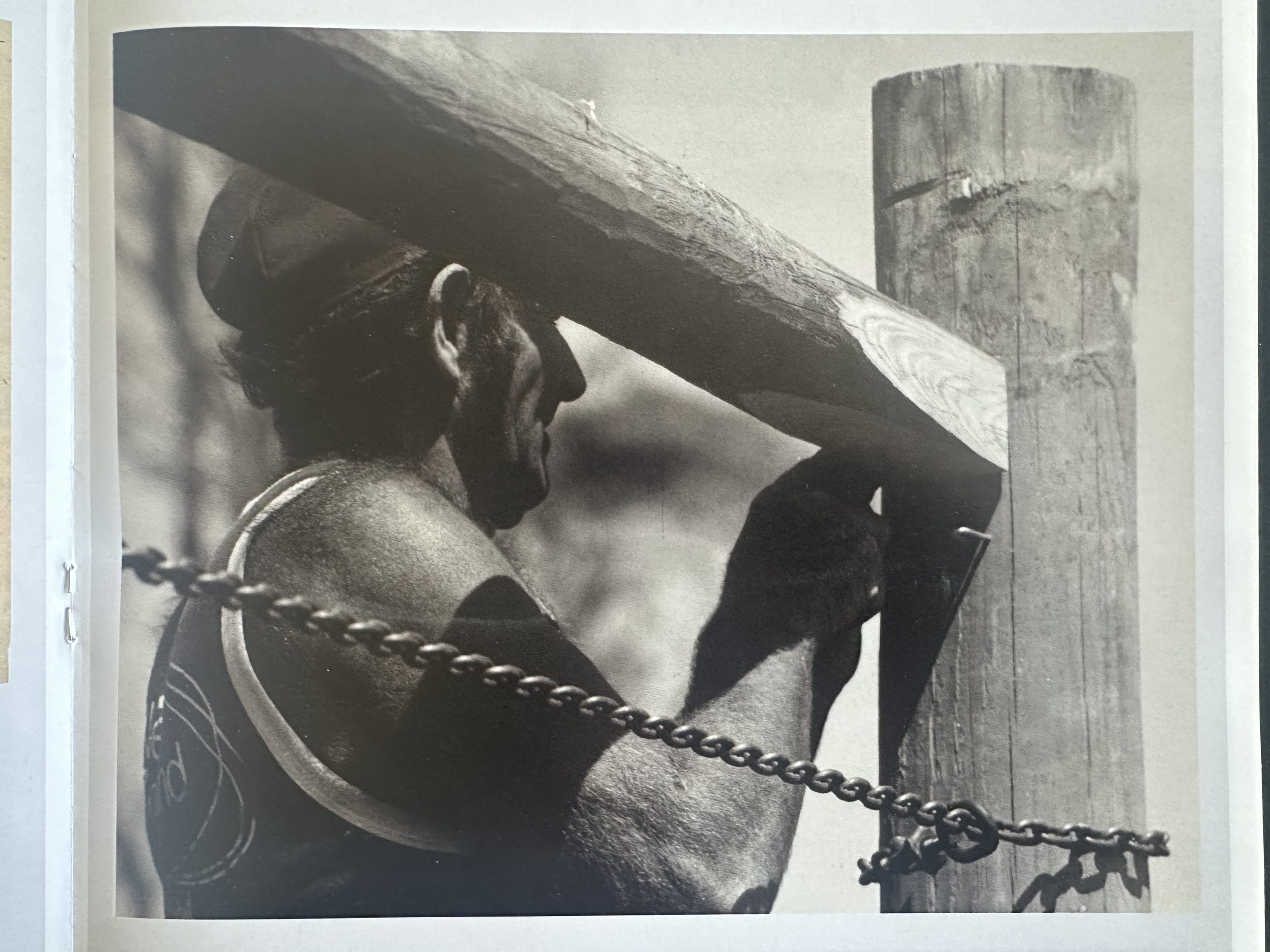
For FCANZ, few names embody the craft, character, and quiet determination of New Zealand fencing quite like A.W. (Bill) Schuler – FCANZ Lifetime Award recipient, Golden Pliers champion, and a man whose influence has shaped generations of fencers.

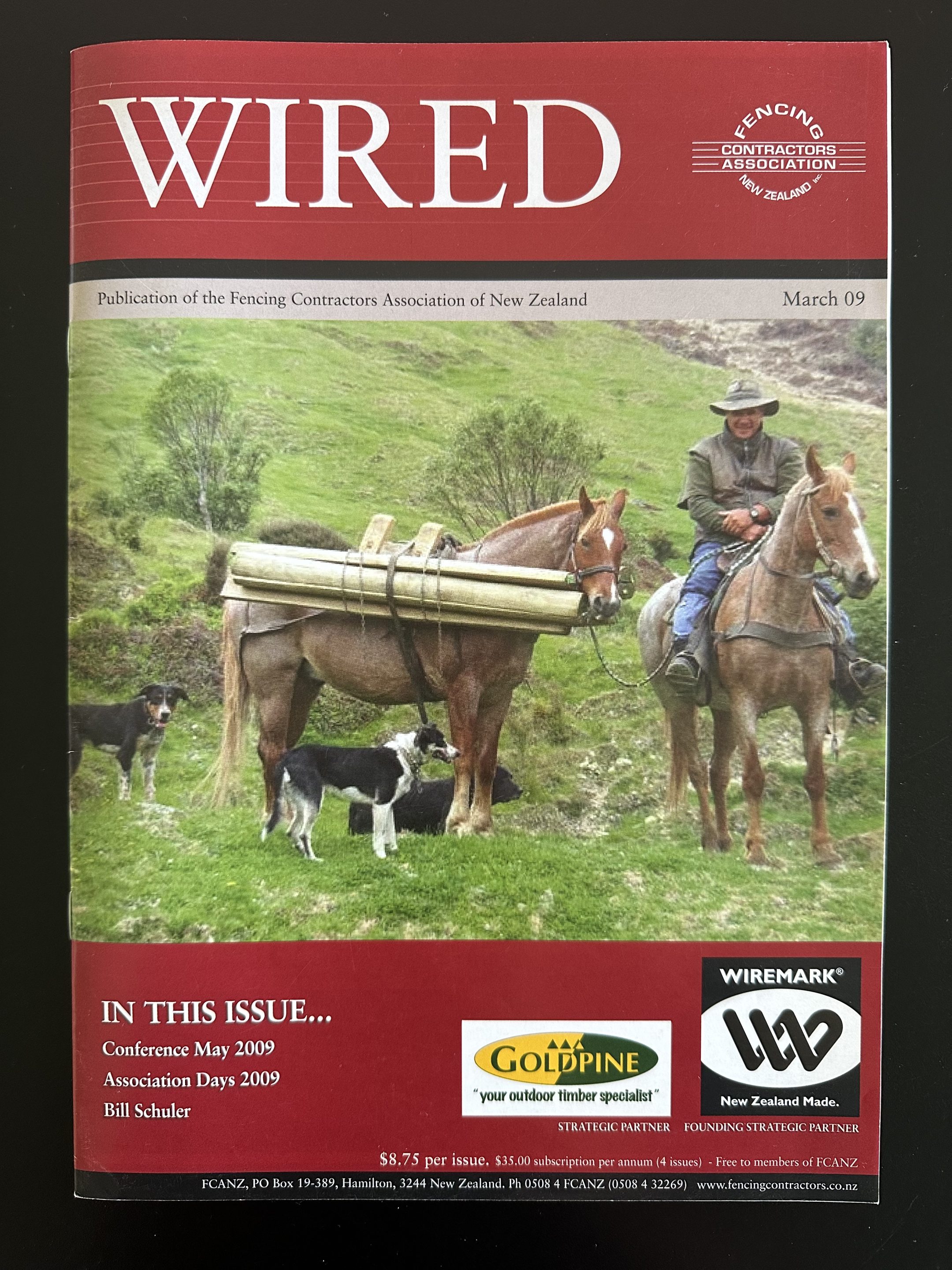
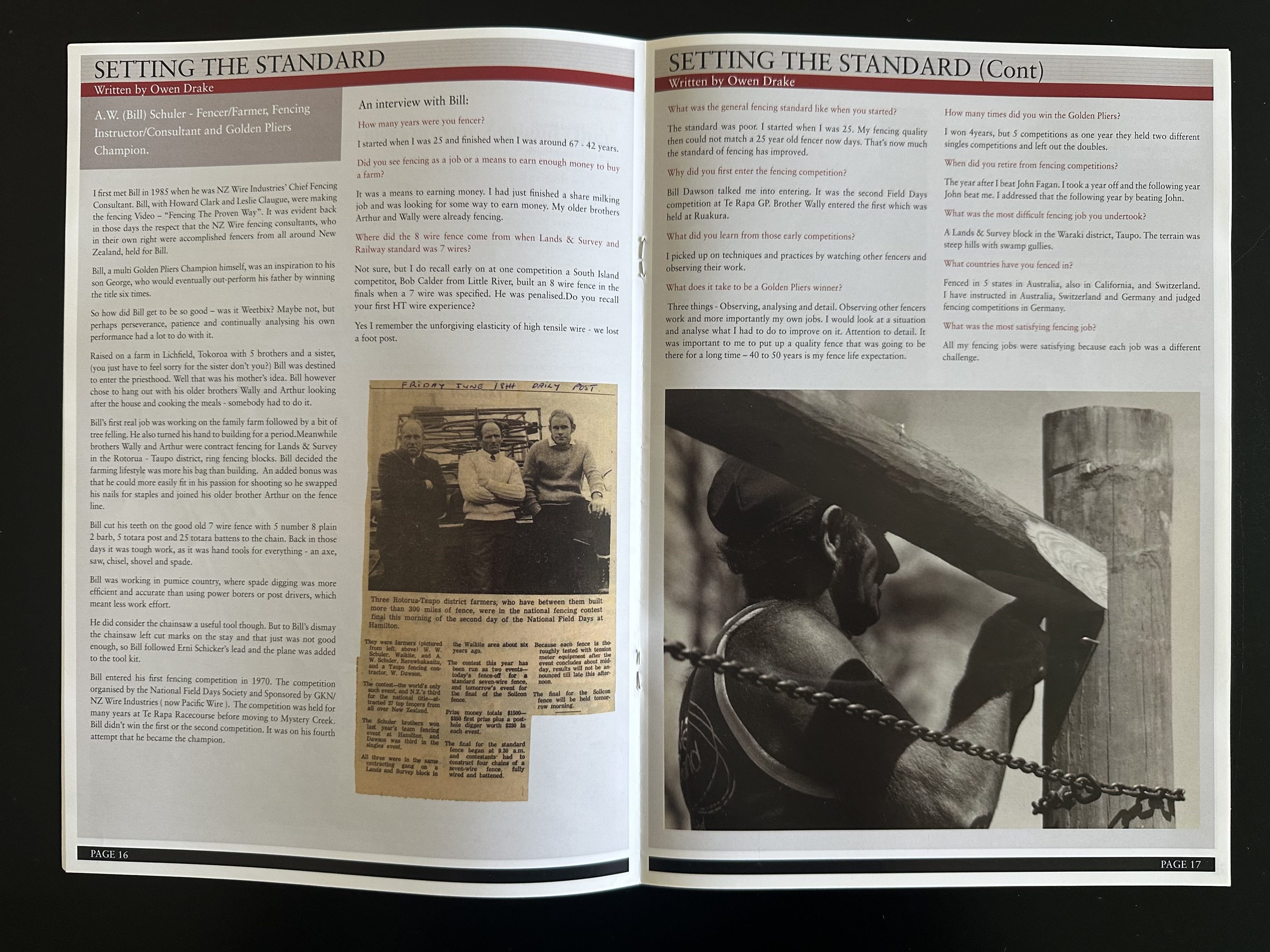
Bill’s story remains a benchmark for what dedication to quality, curiosity, and continual improvement can achieve. As we celebrate 20 years of FCANZ, it’s only fitting to revisit the journey of someone who not only set the standard, but helped define it. This article featured in the March 2009 edition of WIRED.

SETTING THE STANDARD – Written by Owen Drake

A. W. (Bill) Schuler – Fencer/Farmer, Fencing Instructor/Consultant and Golden Pliers Champion.

I first met Bill in 1985 when he was NZ Wire Industries’ Chief Fencing Consultant. Bill, with Howard Clark and Leslie Claugue, were making the fencing Video – “Fencing The Proven Way”. It was evident back in those days the respect that the NZ Wire fencing consultants, who in their own right were accomplished fencers from all around New Zealand, held for Bill.

Bill, a multi Golden Pliers Champion himself, was an inspiration to his son George, who would eventually out-perform his father by winning the title six times.

So how did Bill get to be so good – was it Weetbix? Maybe not, but perhaps perseverance, patience and continually analysing his own performance had a lot to do with it.

Raised on a farm in Lichfield, Tokoroa with 5 brothers and a sister, (you just have to feel sorry for the sister don’t you?) Bill was destined to enter the priesthood. Well that was his mother’s idea. Bill however chose to hang out with his older brothers Wally and Arthur looking after the house and cooking the meals – somebody had to do it.

Bill’s first real job was working on the family farm followed by a bit of tree felling. He also turned his hand to building for a period. Meanwhile brothers Wally and Arthur were contract fencing for Lands & Survey in the Rotorua – Taupo district, ring fencing blocks. Bill decided the farming lifestyle was more his bag than building. An added bonus was that he could more easily fit in his passion for shooting, so he swapped his nails for staples and joined his older brother Arthur on the fence line.
Bill cut his teeth on the good old 7 wire fence with 5 number 8 plain, 2 barb, 5 totara post and 25 totara battens to the chain. Back in those days it was tough work, as it was hand tools for everything – an axe, saw, chisel, shovel and spade.


Bill was working in pumice country, where spade digging was more efficient and accurate than using power borers or post drivers, which meant less work effort.

He did consider the chainsaw a useful tool though. But to Bill’s dismay the chainsaw left cut marks on the stay and that just was not good enough, so Bill followed Erni Schicker’s lead, and the plane was added to the tool kit.

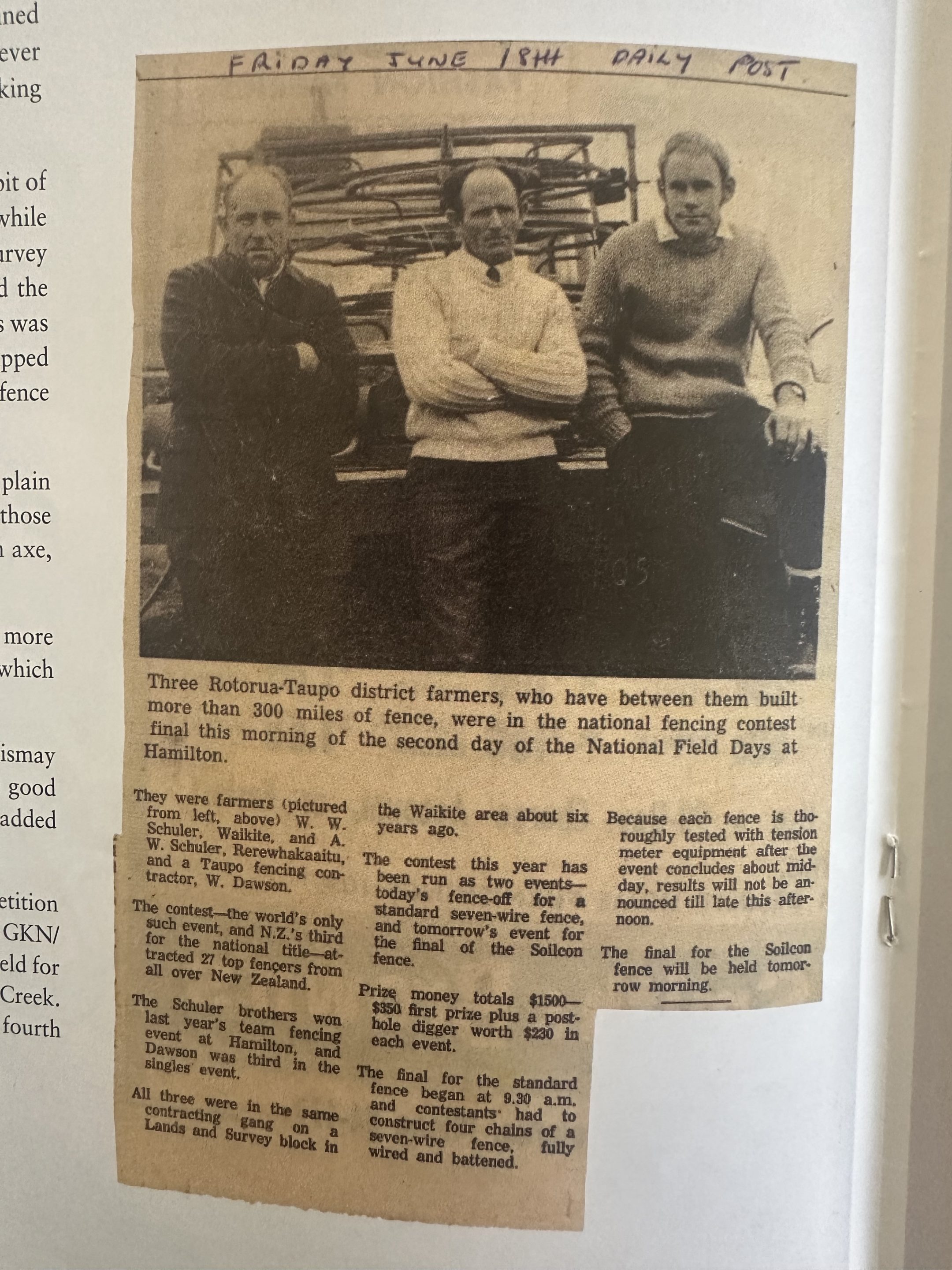
Bill entered his first fencing competition in 1970. The competition organised by the National Field Days Society and Sponsored by GKN/NZ Wire Industries (now Pacific Wire). The competition was held for many years at Te Rapa Racecourse before moving to Mystery Creek. Bill didn’t win the first or the second competition. It was on his fourth attempt that he became the champion.
An interview with Bill
How many years were you fencer?
I started when I was 25 and finished when I was around 67 (42 years).

Did you see fencing as a job or a means to earn enough money to buy a farm?
It was a means to earning money. I had just finished a share milking job and was looking for some way to earn money. My older brothers Arthur and Wally were already fencing.

Where did the 8 wire fence come from when Lands & Survey and Railway standard was 7 wires?
Not sure, but I do recall early on at one competition a South Island competitor, Bob Calder from Little River, built an 8 wire fence in the finals when a 7 wire was specified. He was penalised.

Do you recall your first HT wire experience?
Yes, I remember the unforgiving elasticity of high tensile wire – we lost a foot post.

What was the general fencing standard like when you started?
The standard was poor. I started when I was 25. My fencing quality then could not match a 25 year old fencer now days. That’s how much the standard of fencing has improved.

Why did you first enter the fencing competition?
Bill Dawson talked me into entering. It was the second Field Days competition at Te Rapa GP. Brother Wally entered the first which was held at Ruakura.

What did you learn from those early competitions?
I picked up on techniques and practices by watching other fencers and observing their work.

What does it take to be a Golden Pliers winner?
Three things – Observing, analysing and detail. Observing other fencers work and more importantly my own jobs. I would look at a situation and analyse what I had to do to improve on it. Attention to detail. It was important to me to put up a quality fence that was going to be there for a long time – 40 to 50 years is my fence life expectation.

How many times did you win the Golden Pliers?
I won 4 years, but 5 competitions as one year they held two different singles competitions and left out the doubles.

When did you retire from fencing competitions?
The year after I beat John Fagan. I took a year off and the following year John beat me. I addressed that the following year by beating John.

What was the most difficult fencing job you undertook?
A Lands & Survey block in the Waraki district, Taupo. The terrain was steep hills with swamp gullies.

What countries have you fenced in?
Fenced in 5 states in Australia, also in California, and Switzerland. I have instructed in Australia, Switzerland and Germany and judged fencing competitions in Germany.

What was the most satisfying fencing job?
All my fencing jobs were satisfying because each job was a different challenge.

What was your strangest fencing job?
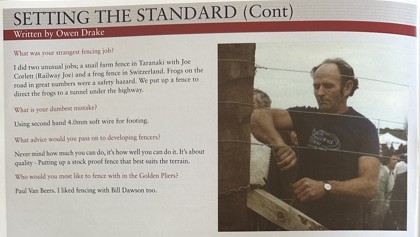
I did two unusual jobs; a snail farm fence in Taranaki with Joe Corlett (Railway Joe), and a frog fence in Switzerland. Frogs on the road in great numbers were a safety hazard. We put up a fence to direct the frogs to a tunnel under the highway.

What is your dumbest mistake?
Using second hand 4.0mm soft wire for footing.

What advice would you pass on to developing fencers?
Never mind how much you can do, it’s how well you can do it. It’s about quality – putting up a stock proof fence that best suits the terrain.

Who would you most like to fence with in the Golden Pliers?
Paul Van Beers. I liked fencing with Bill Dawson too.

Published in WIRED issue 80/March 2026 by Fencing Contractors Association NZ

You may also like From humble beginings

Read WIRED online
Follow us on Facebook

© Fencing Contractors Association NZ (FCANZ)

Posted on

From humble beginings

As FCANZ marks its 20th anniversary, it’s the perfect moment to look back at the early years captured through the pages of WIRED.

2004-2007

These photos from 2004-2007 offer a vivid snapshot of an Association finding its feet, building momentum, and shaping the identity that would carry it forward. From grassroots gatherings to the growing professionalism of the industry, these images remind us how far FCANZ has come—and how the commitment of its members laid the foundations for the organisation we celebrate today.

December 2004

The concept of a Fencing Association is gaining momentum. The first Steering Committee is formed.

July 2005

Survey sent to fencing contractors to establish interest in membership of FCANZ (as an incorporated society). Indicative membership is $150 per annum.

October 2005

FCANZ Rules are adopted and submitted to the Companies Office, with a view to becoming an incorporated society. Membership is $50, with members entitled to received WIRED newsletter, access to the Association’s website, and 0800 number.

An Expression of Interest Form is circulated for the inaugural FCANZ AGM, to be held in Rotorua, May 2007. The AGM included a guest speaker and group discussion.

June 2007

The first appointed Executive Committee of the Fencing Contractors Association of New Zealand, Incorporated. Chair: Wayne Newdick, Committee Members: Robert Best, Simon Fuller, Nick Liefting, Jeremy Klingender, Malcolm Webster, Lance Hare, and Andrew Cave. Founding Strategic Partner: Wiremark.

Published in WIRED issue 80/March 2026 by Fencing Contractors Association NZ

You may also like: FCANZ marks 20 years supporting professional fencers

Read WIRED online
Follow us on Facebook

© Fencing Contractors Association NZ (FCANZ)

Posted on

FCANZ marks 20 years supporting professional fencers

This year marks the 20th anniversary of the Fencing Contractors Association of New Zealand (FCANZ) becoming an incorporated society. Over that time, both the fencing industry and the wider economy have changed significantly, and FCANZ has evolved alongside them.

One of the most notable shifts has been in the rural sector, where landowners increasingly recognise the value of engaging specialist contractors to carry out key on-farm tasks such as fencing. FCANZ President Phil Cornelius says the change in mindset has been gradual but significant.

“Farmers used to do everything themselves, but over the last decade or so there’s been growing acceptance that it often works out cheaper to pay a professional to get the job done properly. That frees farmers up to focus on their stock, while fencing work is completed efficiently and to a high standard.”

When FCANZ was formally incorporated in 2006, two years after the organisation was established, its founding objectives were clear and ambitious. These included lifting the profile and standard of fencing in New Zealand, growing the market for professional fencing contractors, promoting high-quality workmanship, encouraging training and skills development, facilitating information sharing within regions, and providing advice for the benefit of members.

Over time, those objectives have been refined into a clear mission: “To raise the profile of fencing as a recognised trade that embraces best practice, adherence to quality standards, and ongoing professional development.”

This mission is underpinned by three core principles: that fencing is a recognised trade, fencing is chosen as a career, and best practice is adopted across the industry.

As the membership body for a largely unregulated industry, achieving these goals has not been without challenges. While the Fencing Act 1978 sets out responsibilities for boundary fencing, it does not prescribe how fences must be built, nor does it establish enforceable construction standards or industry-wide specifications. The Act defines what may be considered an “adequate fence” and provides examples of fence types, but these are guidance only. In addition, regional and district councils often have their own by-laws relating to fence height and, in some cases, fence style, adding further variation to requirements across the country.

To address this gap, FCANZ has undertaken a major project to develop best-practice technical drawings for a range of fence types.

“Everyone has their own way of doing things, and practices vary between regions and between islands,” says Cornelius. “What these drawings do is draw a line in the sand and say: this is what we, as an organisation with 20 years’ experience, consider to be best practice/minimum standards. Contractors can still work in their own way, but this is about education – for our members and for the people paying for fences. We want everyone to understand what good looks like.”

The drawings are being developed by a panel of fencers from around New Zealand, bringing together decades of hands-on experience. They are undergoing peer review by a further five experienced fencing contractors with extensive practical expertise to ensure their robustness and real-world relevance.

The initial portfolio of drawings, due for release in the first quarter of 2026, will include key rural sector fence types, as well as post-and-rail and paling fence drawings, and will continue to grow as additional fence types and details are developed. The drawings will be available free of charge to FCANZ members via the member-only portal on the Association’s website. They will also be made available for a small fee to support procurement processes for New Zealand-based organisations, such as councils and construction companies.

While FCANZ’s roots are firmly in rural fencing, the Association has broadened considerably over the years. Membership and industry partners now span a multitude of fencing sectors including rural, residential, commercial, and security. Many members work with a wide range of materials across diverse fencing styles and environments, and a significant number have diversified into related areas such as vineyard installations, orchard infrastructure, track building, decking, and retaining walls.

Later this year, FCANZ will launch a revamped website, including a significantly improved online contractor directory for the public. With more than 20,000 visits each year to the directory, FCANZ Executive Director Jaime Bigwood says improving accessibility is critical.

“This is a significant project, but it’s an important one — particularly when it comes to modelling and reinforcing the adoption of best practice across the industry,” says Bigwood. “We run an always-on Google Ads campaign directing people to the directory, helping ensure FCANZ members are the first contractors found when someone searches for a fencer in their area. It’s vital that the user experience is seamless and that our members are easy to find. The directory is just one of many member benefits, and it also plays a role in lifting the visibility and recognition of fencing as a professional trade.”

FCANZ Members test the strength of various footing techniques at a recent Best Practice Day. Best Practice Days are held around the country throughout the year.

ABOUT FCANZ – LEADING THE WAY IN PROFESSIONAL FENCING

The Fencing Contractors Association of New Zealand (FCANZ) is the voice of the fencing industry, dedicated to lifting standards, promoting professionalism, and positioning fencing as a recognised and rewarding career.

FCANZ connects members with the latest in fencing innovation – products, techniques, and industry trends – while providing practical tools like best practice guidelines, templates, and codes of practice to support quality workmanship.

Through flagship events such as the annual conference and nationwide Fencing Best Practice Days, FCANZ offers members valuable opportunities to learn, connect, and grow. These events deliver hands-on insights into new techniques, health and safety, product performance, pricing strategies, and more – helping members stay ahead in a competitive industry.

Written by Jaime Bigwood

The evolution of WIRED – the only fencing industry publication in NZ.


Published in WIRED issue 80/March 2026 by Fencing Contractors Association NZ

You may also like: Weather or not, we fence

Read WIRED online
Follow us on Facebook

© Fencing Contractors Association NZ (FCANZ)